
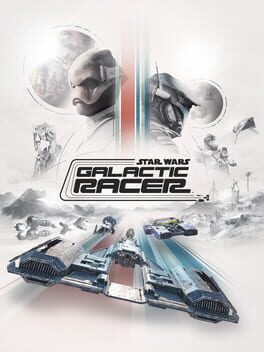
Overview
When Criterion Games’ Burnout franchise stormed the early‑2000s, it redefined the visceral thrill of high‑octane, crash‑centric racing, delivering a blend of speed, spectacle, and unapologetic aggression that few titles could match. The series’ decline after the last main‑line entry left a palpable void in the arcade‑racing niche, a gap that has been partially filled by simulators and open‑world racers but never truly recaptured the pure, adrenaline‑pumping chaos that Burnout championed. In this vacuum, Star Wars: Galactic Racer emerged as an unlikely heir, a mobile‑first title that, despite its modest platform, channels the very spirit of Burnout through its relentless collision mechanics, risk‑reward boost system, and a design philosophy that prizes spectacle over realism.
Galactic Racer arrived under the expansive Star Wars licence, a partnership that historically leans toward cinematic shooters and open‑world adventures. Yet the decision to launch a fast‑paced, arcade‑style racer signaled a strategic pivot: leveraging the franchise’s massive fanbase to test a high‑risk, high‑reward gameplay loop on a broader, more casual audience. The game’s development, led by a studio with roots in both mobile and console experiences, deliberately borrowed from Criterion’s playbook—embracing “boost‑or‑crash” dynamics, environmental destruction, and a reward system that encourages players to flirt with disaster. This hybrid approach has ignited conversation across the industry, positioning Galactic Racer as a potential blueprint for resurrecting the Burnout ethos in a modern, cross‑platform context.
What Happened?
The recent feature on PushSquare highlighted Galactic Racer’s uncanny resemblance to Burnout, noting that the game’s core loop—accelerate, collide, and reap massive boost—mirrors the hallmark mechanics that made the original series a cultural touchstone. The article underscored that, while the title is technically unrelated to Criterion, its design DNA is unmistakable: aggressive AI opponents, spectacular crash animations, and a “risk‑it‑for‑reward” boost meter that punishes reckless driving with spectacular consequences, yet rewards daring maneuvers with exhilarating speed bursts. This alignment has not gone unnoticed by the broader racing community, many of whom have long called for a revival of the Burnout formula on next‑gen hardware.
Developers behind Galactic Racer have been vocal about their inspirations, citing Criterion’s philosophy of “fun first, realism second” as a guiding principle throughout production. In a recent developer diary, they explained that the decision to embed Burnout‑style mechanics within a Star Wars universe was both a creative gamble and a market test—if the blend resonated with players, it could justify a larger investment in a full‑scale console sequel or even a new IP that marries beloved franchise licensing with arcade‑racing sensibilities. The diary also hinted at upcoming updates that will introduce higher fidelity graphics, deeper progression systems, and cross‑play capabilities, suggesting an ambition to transcend the mobile niche and stake a claim in the broader racing genre.
Analysis
From a market perspective, Galactic Racer’s emergence at a time when mobile gaming accounts for over half of global game revenue offers a compelling case study in genre cross‑pollination. The title’s success could signal to publishers that there is still a lucrative appetite for pure‑arcade racing experiences, especially when paired with a franchise as globally resonant as Star Wars. Moreover, the game’s ability to deliver high‑impact crashes on modest hardware challenges the long‑standing assumption that such visceral experiences require console‑grade processing power, potentially lowering the barrier for future developers to experiment with similar mechanics.
Competitively, the resurgence of Burnout‑like design places pressure on established racing studios such as Codemasters and Turn 10, which have traditionally dominated the market with realism‑heavy franchises like F1 and Forza. If EA or its partners decide to capitalize on Galactic Racer’s momentum, we may witness a renewed arms race in the arcade‑racing space, prompting innovations in physics simulation, destructible environments, and live‑service monetisation models. However, technical hurdles remain: translating the chaotic, high‑speed collisions of a mobile engine to next‑gen consoles without sacrificing performance will demand sophisticated optimisation and possibly new middleware solutions.
XPLog Opinion
At XPLog UK, we view Galactic Racer not merely as a novelty tie‑in, but as a litmus test for the viability of a Burnout renaissance. The title proves that the core loop that once defined a generation of racers still resonates when stripped to its essentials—speed, danger, and reward. Publishers should heed this signal and consider allocating resources toward a full‑blown, multi‑platform revival, ideally under the stewardship of a studio that can marry Criterion’s heritage with modern live‑service infrastructure. Ignoring this momentum would be a missed opportunity to re‑energise a segment of the market that has been underserved for years.
Final Thoughts
As the industry eyes the upcoming Summer Game Fest and Gamescom showcases, all eyes will be on whether any major publisher will announce a concrete plan to resurrect Burnout’s legacy, perhaps leveraging the lessons learned from Star Wars: Galactic Racer. Until then, the game stands as a bold experiment—proof that the appetite for reckless, high‑speed racing endures, and that the next great arcade racer may be just a franchise partnership away.