.png)
Overview
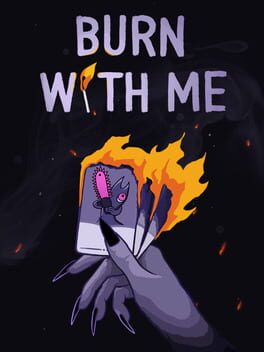
In a market saturated with procedural‑generated deck‑builders and endless‑run card experiences, a modest indie title has emerged that dares to place the artist’s own hand at the centre of its visual language. Burn With Me, crafted by the enigmatic illustrator Eva Manuilovich, is not merely another demon‑themed card game; it is a kinetic tableau where each flick of a stylised index finger animates the very act of dealing, and a thumb‑up gesture rewards the player’s triumph. This tactile sensibility arrives at a moment when the industry is wrestling with the paradox of hyper‑digital convenience versus the yearning for tangible, handcrafted aesthetics, a tension first explored in the early 2010s by physical‑card indie successes such as Inscryption and the later resurgence of tabletop‑inspired digital hybrids.
The timing of Burn With Me’s announcement dovetails with a broader renaissance of “finite” deck mechanics, a design philosophy championed by titles like Balatro that promise a bounded, repeatable experience without the fatigue of endless grinding. Yet where Balatro leans on minimalist vector art and algorithmic randomness, Burn With Me injects a personal, almost ritualistic element: the artist’s own right hand, rendered in painstaking hand‑drawn detail, becomes a recurring character that deals, celebrates, and reaches for the spoils. This decision signals a deliberate pushback against the homogenisation of visual pipelines in indie development, reminding both players and publishers that individuality can be a market differentiator.
What Happened?
During a recent showcase streamed on the indie‑focused platform IndieCade Live, Manuilovich revealed that the game will launch on PC via Steam and the Epic Games Store, with console ports slated for the following quarter. The core loop revolves around a series of duels against demonic opponents, each round presenting a target score that must be met through a limited hand of cards. The twist lies in the animation: as the player’s hand of cards is dealt, the artist’s illustrated hand appears on the right side of the screen, its index finger flicking each card into the play area with a fluid motion that mirrors real‑world card dealing. Upon achieving the score, the hand offers a thumbs‑up before languidly reaching toward the victorious card, a subtle yet powerful visual cue that reinforces player agency.
Manuilovich also disclosed that the game’s deck is intentionally finite, comprising a curated set of twenty‑seven demon cards, each hand‑drawn with a distinct personality and lore snippet. This design choice eliminates the “deck‑bloat” that plagues many modern card games, ensuring that each match feels like a concise, repeatable ritual rather than an endless grind. Development began in early 2022, with the artist initially sketching the hand as a personal signature for a series of tarot‑style illustrations. The concept evolved when a prototype demonstrated that the hand could serve as a functional UI element, prompting a full‑scale pivot from a pure art project to a playable game. Funding was secured through a modest Kickstarter campaign that exceeded its £25,000 goal, allowing the team to hire a small programming studio to translate the hand‑drawn assets into an interactive Unity engine.
Analysis
The market impact of Burn With Me may be understated at first glance, but its hybrid of handcrafted visual identity and finite deck design taps into several converging trends. First, there is a growing appetite among core gamers for experiences that reward mastery over quantity; the limited card pool forces strategic depth, reminiscent of classic collectible card games where deck‑building is a cerebral exercise rather than a monetary arms race. Second, the hand‑drawn aesthetic aligns with the rising consumer desire for authenticity, a reaction to the algorithm‑driven art pipelines that dominate AAA pipelines. By foregrounding the artist’s literal hand, the title creates a meta‑narrative about creation itself, a concept that could inspire a wave of similarly personalised UI designs across indie titles.
From a platform perspective, the decision to launch simultaneously on PC storefronts and later on consoles reflects a strategic hedging against the volatility of console exclusivity deals that have reshaped the industry since the PlayStation 5 and Xbox Series X launch cycles. Moreover, the game’s modest technical requirements—essentially 2D sprite rendering with minimal particle effects—position it well for next‑gen consoles’ indie sections, where discoverability algorithms often favour titles with high engagement metrics over sheer graphical fidelity. Competitively, Burn With Me will sit alongside other finite‑deck indie darlings such as Roguebook and Loop Hero, potentially carving out a niche that values artistic intimacy over sheer content volume.
XPLog Opinion
At XPLog UK we view Burn With Me as a bold statement that the indie ecosystem still has room for daring visual experiments that double as gameplay mechanics. While many developers chase the next procedural algorithm or micro‑transaction model, Eva Manuilovich’s choice to embed her own hand into the UI is a reminder that personality can be weaponised as a unique selling point. If the game delivers on its promised strategic depth, it will not only solidify its place as a cult favourite but also encourage publishers to fund projects that prioritize artistic signature over mass‑produced content pipelines.
Final Thoughts
Burn With Me arrives at a crossroads where players are craving concise, meaningful play sessions wrapped in a distinct visual language. Its finite deck, hand‑drawn demons, and the literal presence of the creator’s hand combine to form a compelling proposition that could reshape expectations for indie card games in 2027 and beyond. Keep an eye on the official release window slated for early Q4 2026, and watch for subsequent console roll‑outs in Q1 2027—these dates will be the first true test of whether a hand‑drawn hand can indeed deal a winning blow to the industry’s prevailing trends.